


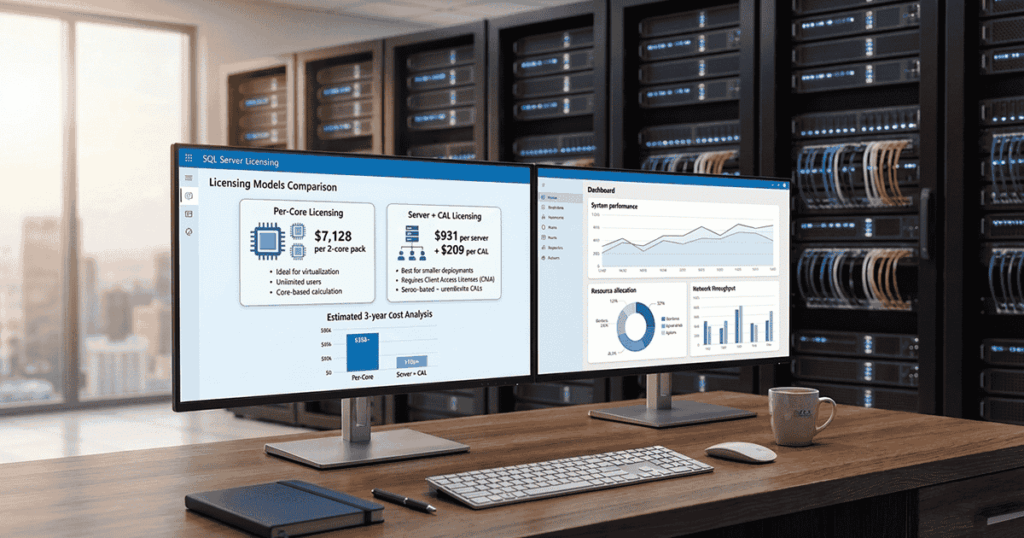
Microsoft licenses SQL Server two different ways, per-core and Server + CAL, and picking the wrong one either overpays for capacity you don’t need or leaves you under-licensed. This guide walks through both models in plain language, using real pricing, so you can size it correctly before you buy.
If you’ve already decided which edition, Standard or Enterprise, you need and just want the edition comparison, see our SQL Server 2025 licensing guide: Standard vs Enterprise instead. This guide is about the licensing model, which applies across every SQL Server version.
The Short Answer
Server+CAL usually wins when: you have a known, countable group of users or devices accessing the database, and that number is small to moderate, roughly under 20 to 25 users on Standard Edition.
Per-core usually wins when: you don’t know or can’t count how many users will connect (a public-facing web application, for example), or your user count is high enough that CALs would cost more than licensing the cores directly.
Most small and mid-size businesses with an internal line-of-business database start with Server + CAL. Growth past a certain user count, or any internet-facing application, tends to push toward per-core.
How Server + CAL Licensing Works
You buy two things: a Server license for the machine running SQL Server, and a Client Access License, a CAL, for every user or device that connects to it, directly or indirectly. Microsoft’s published pricing for SQL Server 2022 Standard puts the Server license at $989 and each CAL at $230.
That means a 10-user setup costs one Server license plus 10 CALs. In our catalog, that’s a SQL Server 2019 Standard, 10-CAL edition at $799, a fixed bundle that already includes the server license and CAL count together rather than pricing them as separate line items. Need more users later, a 100-CAL edition runs $1,499 for that much higher ceiling.
The CAL model is straightforward to reason about when your user count is known and stable: count your users, buy that many CALs, done. It gets expensive fast once user count climbs, and it doesn’t work at all for scenarios where “how many users” isn’t a knowable number.
How Per-Core Licensing Works
Instead of licensing users, you license the processor cores on the machine running SQL Server, with no cap on how many users or devices connect. Microsoft requires a minimum of 4 core licenses per physical processor, sold in 2-core packs. Their published 2022 pricing runs $3,945 per 2-core pack for Standard Edition, and $15,123 per 2-core pack for Enterprise, so a typical 8-core server on Standard prices out well into five figures at Microsoft’s own rates.
This is where buying genuine licenses at real pricing instead of Microsoft’s list rate matters most. Our SQL Server 2022 Standard, unlimited-core, unlimited-CAL, single server license covers an entire server at $1,999.99, and the current-generation SQL Server 2025 Standard, 36-core, unlimited-CAL edition runs $2,099.99. For Enterprise-tier workloads, SQL Server 2025 Enterprise, 40-core, unlimited-CAL is $2,599.99.
Per-core licensing is the only option that makes sense once user count is unpredictable, an e-commerce site’s database doesn’t have a fixed “user list,” every visitor is a potential connection.
Side-by-Side Comparison
| Server+CAL | Per-Core | |
|---|---|---|
| Best for | Known, countable internal users | Unknown or high user counts, internet-facing apps |
| Pricing basis | Server license + CAL per user/device | Core count on the machine |
| Cost predictability | Very predictable if user count is stable | Fixed regardless of user count |
| Grows expensive when | User count climbs past ~20-25 | Rarely, cost is capped by core count, not usage |
| Typical buyer | Internal department database, small business app | Public-facing application, growing user base |
A Worked Example
Say you’re running an internal reporting database for 15 employees, all on-premises, no external access. Under Server+CAL, that’s roughly $989 plus 15 CALs at $230 each at Microsoft’s published rates, well over $4,400. Buying the equivalent as an Indigo bundle, the 10-CAL edition at $799 covers 10 of those users directly, with the 100-CAL edition at $1,499 comfortably covering all 15 with headroom to grow, still a large gap below Microsoft’s own per-CAL math.
Now say that same database needs to serve a customer-facing web portal instead of just internal staff, an unknown, growing number of external users. Per-core is the only model that fits: license the server’s cores once, and connection count stops mattering. The unlimited-core, unlimited-CAL edition at $1,999.99 covers that scenario without tracking a single CAL.
Common Licensing Mistakes to Avoid
Licensing per-core when you have a small, known user base. If you can count your users and that number is well under 20-25, Server+CAL is almost always cheaper. Don’t default to per-core out of habit or because it sounds more “enterprise.”
Under-counting CALs. A CAL is required for every user or device that accesses SQL Server data even indirectly, through a middle-tier application, for example, not just users who log in directly. Miscounting this is one of the most common licensing compliance issues.
Ignoring the minimum core requirement. Per-core licensing requires a minimum of 4 cores per physical processor regardless of your server’s actual core count, factor that into your sizing before assuming a smaller server saves money.
Not planning for growth. If your user count is trending upward, price out both models at your expected count 12-18 months out, not just today’s number, before locking in Server+CAL.
Frequently Asked Questions
Can I switch from Server+CAL to per-core later?
Yes, but it means purchasing new per-core licenses rather than converting existing CALs, so it’s worth sizing correctly up front rather than switching after the fact.
Does per-core licensing have a minimum core count?
Yes, a minimum of 4 core licenses per physical processor applies regardless of the server’s actual core count.
What counts as a CAL under Server+CAL licensing?
Any user or device that accesses or uses SQL Server data or services, including indirect access through a separate application layer, requires a CAL.
Is per-core always more expensive than Server+CAL?
No. For a small user count it usually costs more, but past a certain number of users, or for any application with an unpredictable or public user base, per-core becomes the cheaper and often the only workable option.
Do these licensing models apply to every SQL Server version?
Yes, per-core and Server+CAL are Microsoft’s standard licensing models across SQL Server versions. Edition availability (Standard versus Enterprise) and specific pricing vary by version, see our 2025 edition guide for the current generation specifically.
Buy Genuine SQL Server Licenses
Both licensing models available as genuine, perpetual licenses:
-

-
-
-
Sale!
-
Sale!

Not sure which model fits your environment? Contact us with your user count and deployment type (internal vs. public-facing) and we’ll help you size it before you buy.
We’re a US veteran and family-owned business selling genuine Microsoft licenses since 2016, with 100,000+ customers and a 4.9 out of 5.0 rating from over 500 Trustpilot reviews.
Discover more from Indigo Software
Subscribe to get the latest posts sent to your email.


