


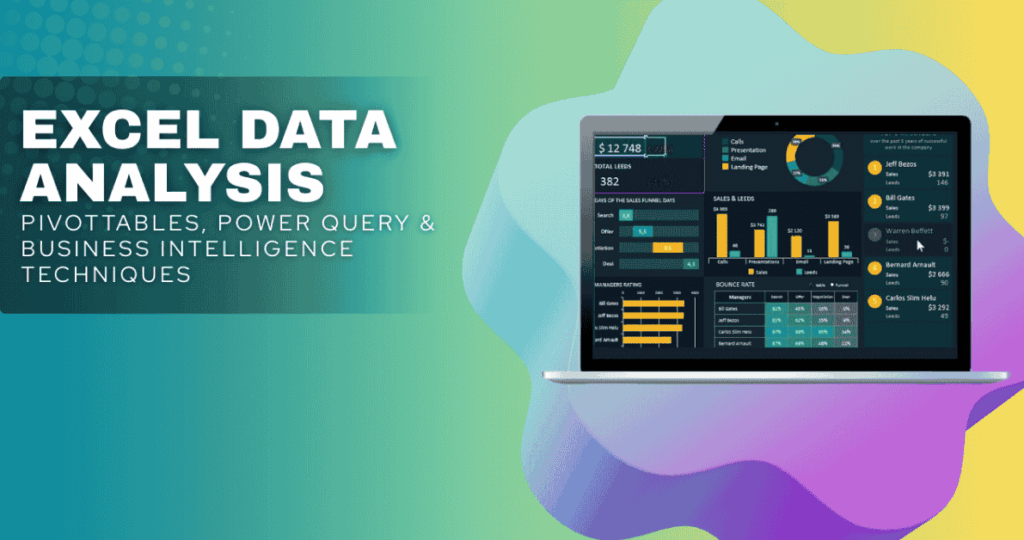
Most Excel users know how to write a SUM formula and maybe build a basic chart. But the tools that separate a competent spreadsheet user from someone who can genuinely transform messy business data into automated, trustworthy insights are PivotTables at depth, Power Query, and the data modeling layer that connects them.
This guide is for business analysts, finance professionals, and operations managers who have moved past the basics and want to build reporting systems that run themselves — where the work happens once and the output updates automatically as new data comes in.
We will walk through advanced PivotTable techniques that most users never discover, the full Power Query ETL workflow with real-world business scenarios, data modeling in the Excel Data Model, and the automation and dashboard techniques that turn one-time analysis into repeatable business intelligence.
Prerequisites: This guide assumes familiarity with basic Excel functions (SUM, VLOOKUP or XLOOKUP, basic formatting) and some experience building simple PivotTables. If you are brand new to PivotTables, spend 30 minutes with the basics first — the techniques here build on that foundation.
Start Here: Data Architecture That Makes Everything Easier
Before touching a PivotTable or opening Power Query, the structure of your source data determines how smoothly everything downstream works. Getting this right prevents 80% of the problems that make Excel BI frustrating.
The Tabular Data Rule — and Why It Matters
Every advanced Excel analysis tool — PivotTables, Power Query, the Data Model — is designed to work with data in tabular format: one row per record, one column per attribute, headers in row 1 and nowhere else, no merged cells, no summary rows baked into the data range.
When your data violates these rules (and it often will when it comes from accounting systems, ERP exports, or other people’s spreadsheets), the first job is getting it into tabular shape. That is literally what Power Query was built for.
| Bad Structure (Fix This First) | Good Structure (What You Want) |
| Months as column headers (Jan, Feb, Mar…) | Single ‘Month’ column with month values in rows |
| Summary rows embedded in data (subtotals mid-table) | Raw data only — summaries generated by PivotTable |
| Merged cells for categories spanning multiple rows | Category value repeated in every row that belongs to it |
| Multiple header rows | Single header row with descriptive column names |
| Data stored in multiple sheets by time period | Single table with a Date or Period column to slice by |
| Numbers stored as text (left-aligned, apostrophe prefix) | Numbers stored as numbers (right-aligned, aggregatable) |
Format as Table: The Non-Negotiable First Step
Every data range you plan to use with PivotTables or Power Query should be formatted as an Excel Table (Insert > Table, or Ctrl+T). This is not just a visual choice — it has structural benefits:
- Tables expand automatically when you add new rows. Your PivotTable and Power Query sources stay current without manually updating range references.
- Table columns are referenced by name rather than cell address. Formulas like [@Sales] instead of =D2 are more readable and more robust.
- Structured references work correctly when rows are inserted, deleted, or reordered.
- Power Query imports Excel Tables cleanly and picks up schema changes automatically.
Name your tables meaningfully when you create them. The default Table1, Table2 naming makes data models and queries much harder to read. Use names like tblSales, tblProducts, tblRegions — the tbl prefix is a convention that helps distinguish tables from named ranges and worksheets.
Advanced PivotTable Techniques That Most Users Never Find
Calculated Fields vs. Calculated Items: Understanding the Difference
Most PivotTable users know they can add sum, count, or average aggregations. Fewer know about Calculated Fields and Calculated Items — two completely different mechanisms that solve different problems and confuse each other if mixed up.
Calculated Fields create a new data field by performing a calculation on other data fields. The calculation happens at the row level before aggregation. Right-click inside the PivotTable, choose Calculated Field, and build a formula using your field names.
Calculated Field Example — Gross Margin %
= Gross_Profit / Revenue
This creates a new field that shows gross margin as a ratio for each row in your source data, then aggregated up through the PivotTable hierarchy. Good for: ratios, derived metrics, KPIs that need to be computed at row level.
Calculated Items create a new virtual row or column within a specific field by combining or computing existing items in that field. These work at the aggregated level, not the row level.
Common mistake: Adding a Calculated Item for a percentage of two row items (e.g., East Region / Total) when you actually want a Calculated Field calculating a rate at the row level. Get this backwards and your percentages will be wrong — sometimes obviously wrong, sometimes subtly so. If your calculation involves a rate or ratio between two data columns, use a Calculated Field. If you are creating a new category derived from existing category values, use a Calculated Item.
Value Field Settings: The Aggregation Options Most People Ignore
Right-clicking any value field in a PivotTable and choosing Value Field Settings reveals aggregation options beyond Sum and Count that are genuinely useful for business analysis:
- Average — useful for per-transaction or per-unit metrics where you want the typical value rather than the total
- Max/Min — quickly surface best and worst performers across any category dimension
- StdDev — add standard deviation to identify which products, regions, or periods have unusually variable performance
- Distinct Count — in the Data Model (more on this shortly), counts unique values rather than total occurrences; essential for customer counts, unique transaction IDs, or non-duplicated measures
The Show Values As tab within Value Field Settings is where the most powerful options live:
- % of Grand Total / % of Column Total / % of Row Total — automatically compute share-of-total without manual formulas
- % Difference From — show how each period compares to a baseline period (e.g., month-over-month or vs. prior year)
- Running Total In — convert a sales column into a cumulative YTD figure with a single setting change
- Rank Largest to Smallest — automatically rank products, regions, or salespeople within the PivotTable without RANK formulas
Grouping Dates: Automatic and Manual
When you add a date field to a PivotTable, Excel can group it automatically by year, quarter, month, week, or day — or any combination. Right-click any date item and choose Group to set the grouping levels. For most business reporting, Year + Quarter + Month gives you a drill-down hierarchy.
For custom groupings — fiscal years that do not match calendar years, non-standard quarters, or 4-4-5 retail calendars — automatic grouping will not work. The solution is to add a calculated calendar column to your source data with the correct period labels, then use that column as your date dimension in the PivotTable.
Formula: Fiscal Year Grouping (April start)
=IF(MONTH([@Date])>=4, “FY”&YEAR([@Date])&”/”&RIGHT(YEAR([@Date])+1,2),
“FY”&YEAR([@Date])-1&”/”&RIGHT(YEAR([@Date]),2))
Add this as a column in your source table, then use that column in your PivotTable Row or Column area for proper fiscal grouping.
Slicers and Timelines: Interactive Dashboard Controls
Slicers are the visual filter buttons you click to filter a PivotTable by dimension — product category, region, department, sales rep. Timelines are a date-specific slicer that provides a sliding date range control. Both can be connected to multiple PivotTables simultaneously through Report Connections, which is what makes them the core of a dashboard.
- Insert a Slicer: click any cell in your PivotTable, go to PivotTable Analyze > Insert Slicer, and select the fields you want as filter controls.
- Connect one Slicer to multiple PivotTables: right-click the Slicer, choose Report Connections, and check every PivotTable in the workbook that should respond to this filter. All checked PivotTables will update simultaneously when the Slicer is clicked.
- Arrange your Slicers as a filter panel on a dashboard sheet. Size consistently, align with Arrange > Align tools, and set a consistent color style to make the interface feel designed rather than assembled.
Slicer alignment shortcut: Select all your Slicers at once with Ctrl+click, then use the Format > Align tools on the ribbon to align left edges and distribute spacing evenly. Takes 30 seconds and makes the difference between a dashboard that looks professional and one that looks like a prototype.
GETPIVOTDATA: The Formula Most Analysts Avoid but Shouldn’t
When you type an equals sign and click a cell inside a PivotTable, Excel writes a GETPIVOTDATA formula rather than a simple cell reference. Most analysts immediately turn this off (PivotTable Analyze > uncheck Generate GetPivotData). That is usually wrong.
GETPIVOTDATA is more powerful than a cell reference because it references the value by its position in the PivotTable hierarchy rather than by cell address. This means if the PivotTable layout changes — rows reorder, new items appear, filter changes — the GETPIVOTDATA formula still finds the right value. A simple cell reference would silently return the wrong number.
GETPIVOTDATA syntax
=GETPIVOTDATA(“Revenue”, $A$3, “Region”, “West”, “Year”, 2025)
// Returns Revenue for West Region, 2025 — regardless of where it sits in the layout
Use GETPIVOTDATA when building summary tables or executive snapshots that pull specific values from a PivotTable. It is significantly more reliable than cell references for this purpose.
Power Query: The ETL Workflow Every Business Analyst Needs
Power Query is the Extract, Transform, Load engine built into Excel (and Power BI). It connects to data sources, applies transformation steps as a recorded sequence, and loads the result into your workbook. When your source data updates, you hit Refresh and all transformations run again automatically — no manual reformatting required.
This is the difference between spending three hours every month reformatting a report export and spending three hours once to build the Power Query that does it for you in 30 seconds forever.
Connecting to Data Sources
Power Query connects to an extensive range of sources through the Data > Get Data menu:
- Excel workbooks (other files, not just the current one)
- CSV, TXT, and fixed-width flat files
- SQL Server, Azure SQL, and other relational databases
- SharePoint lists and document libraries
- Web pages (table scraping from URLs)
- REST APIs returning JSON or XML
- Microsoft Dataverse, Dynamics, and other enterprise systems
For most business analysts, the most common source is a folder of CSV or Excel exports from an ERP, CRM, or accounting system. The Folder connector is particularly powerful here: point Power Query at a folder, and it automatically combines all files in that folder into a single table — with a column tracking which file each row came from. This is how you handle monthly export files without ever manually copying and pasting data again.
The Power Query Interface: Thinking in Steps
Every action in Power Query is recorded as a step in the Applied Steps pane on the right side of the editor. Each step shows the M code that performs the transformation. The complete sequence from source to output is your query — and it is repeatable, editable, and transferable.
This is a different mental model than working with cells. You are defining a pipeline, not manipulating data directly. If a step goes wrong, you delete that step and try again. If your source format changes, you edit the relevant step. Nothing happens to your source data.
Essential Power Query Transformations for Business Data
Unpivoting: Turning Wide Tables into Tall Ones
The most common structural problem in business data is months, years, or categories stored as column headers rather than row values. Power Query’s Unpivot Columns solves this in two clicks.
- Select the columns that contain the category values (the month columns, year columns, etc.) — not the ID or dimension columns.
- Right-click the selected columns and choose Unpivot Columns.
- Power Query creates two new columns: Attribute (containing the old column headers) and Value (containing the values). Rename these to something meaningful: Month and Revenue, for example.
M Code Generated by Unpivot
= Table.UnpivotOtherColumns(
Source,
{“Product”, “Region”}, // columns to KEEP as-is
“Month”, // new attribute column name
“Revenue” // new value column name
)
Merging Queries: The Power Query VLOOKUP
Merge Queries is Power Query’s equivalent of VLOOKUP or JOIN in SQL. You match rows from two queries on a shared key column and bring columns from the second table into the first.
- Load both tables into Power Query (or reference them from existing queries).
- In your main query, go to Home > Merge Queries.
- Select the matching column in each query (e.g., ProductID in both tables).
- Choose your join type: Left Outer (keep all rows from the main query, add matching data from the lookup — equivalent to VLOOKUP), Inner (only rows with matches in both tables), Full Outer (all rows from both tables).
- Expand the merged column by clicking the expand icon in the new column header and selecting which fields to bring across.
M Code: Left Merge (VLOOKUP equivalent)
= Table.NestedJoin(
SalesQuery, “ProductID”,
ProductsQuery, “ProductID”,
“ProductDetails”,
JoinKind.LeftOuter
)
Performance tip: If you are merging a large transaction table with a small reference table (product names, cost codes, region mappings), make the large table the primary query and the small table the lookup. This is the more efficient direction for Power Query’s evaluation engine.
Appending Queries: Combining Data from Multiple Files
Append Queries stacks two or more queries vertically — equivalent to copying and pasting data below existing rows. This is how you combine data from multiple files, periods, or sources into one unified table.
The Folder connector does this automatically for files in the same folder. For files in different locations or with different structures that need transformation before combining, the manual Append workflow is the right tool:
- Load each source into Power Query and apply any necessary transformations to make column names and types consistent.
- In one query, go to Home > Append Queries > Append Queries as New.
- Add all the queries to be stacked and click OK.
Power Query matches columns by name, not position. If one source calls the column Revenue and another calls it Total Revenue, they will not merge correctly. Rename columns in each source query first to establish a consistent schema.
Custom Columns: Writing M Formulas
Add Column > Custom Column opens a formula editor where you can write M expressions to compute new values. The syntax is different from Excel formulas but accessible once you understand the core patterns:
Custom Column Examples
// Simple arithmetic
= [Gross Profit] / [Revenue]
// Conditional logic (equivalent to IF)
= if [Sales] > 10000 then “High” else if [Sales] > 5000 then “Mid” else “Low”
// Text manipulation
= Text.Upper(Text.Trim([Region]))
// Date extraction
= Date.Year([OrderDate])
// Null handling
= if [Discount] = null then 0 else [Discount]
Grouping and Aggregating in Power Query
Power Query can perform aggregations before loading into Excel — useful when your source is large and you only need summary-level data. Home > Group By lets you define dimensions to group by and aggregations (Sum, Average, Count, Min, Max) for each measure column.
M Code: Group By with Multiple Aggregations
= Table.Group(
Source,
{“Region”, “Product”}, // group by these columns
{
{“Total Revenue”, each List.Sum([Revenue]), type number},
{“Order Count”, each Table.RowCount(_), Int64.Type},
{“Avg Order Value”, each List.Average([Revenue]), type number}
}
)
Error Handling and Data Quality in Power Query
Real business data is messy. Power Query surfaces errors in cells rather than silently propagating wrong values — which is helpful for quality control but means you need to handle them explicitly.
- Remove Errors: right-click a column > Remove Errors eliminates rows where that column has an error value. Use this when error rows are genuinely invalid and should not be in the output.
- Replace Errors: right-click a column > Replace Errors substitutes a defined value (usually 0 or null) for error cells. Use this when errors represent a known condition like a zero-denominator division.
- Replace Values: transforms specific values throughout a column — useful for standardizing inconsistent text entries (“NY”, “New York”, “N.Y.” all becoming “New York”) or replacing nulls with defaults.
- Data Type changes: always explicitly set column data types after loading. Power Query’s automatic detection is good but not perfect, and a column stored as Text will not aggregate correctly in a PivotTable.
The Excel Data Model: Building Relationships Without VLOOKUP
The Excel Data Model is a relational engine embedded in Excel, powered by the same Analysis Services technology that runs Power BI. When you load data into the Data Model instead of a worksheet, you gain the ability to create relationships between tables, write DAX measures, and use DISTINCTCOUNT aggregations — capabilities that are impossible with standard PivotTables built on single flat tables.
When to Use the Data Model vs. a Flat Table
Standard PivotTables work well for single-table analysis with straightforward aggregations. The Data Model is the right choice when:
- Your analysis requires data from multiple related tables (sales transactions, products, customers, calendar) and you want to avoid duplicating columns by flattening everything into one giant table.
- You need DISTINCTCOUNT — counting unique customers, unique orders, or unique products rather than total row counts.
- You want DAX calculated measures that cannot be expressed as simple Calculated Fields (rolling averages, period-over-period comparisons, filtered aggregations).
- Your dataset is large enough that flat-file merging would create a performance problem.
Building Relationships in the Data Model
- Load your source tables into the Data Model by checking ‘Add this data to the Data Model’ when loading from Power Query or by using Data > Data Model > Manage in the Diagram View.
- In the Data Model Diagram View (Data > Data Model), drag and drop to create relationships between tables on their shared key columns.
- Verify cardinality: a relationship between a fact table (many rows per product) and a dimension table (one row per product) should be Many-to-One. If Excel shows Many-to-Many, you likely have a data quality issue — duplicate keys in what should be a unique dimension table.
- Set the cross-filter direction to Single (from dimension to fact) in most cases. Bidirectional filtering can create ambiguity in complex models.
Once relationships are defined, a PivotTable built on the Data Model can pull fields from any connected table without requiring VLOOKUP or Merge. The relationship engine handles the join automatically.
Introduction to DAX Measures
DAX (Data Analysis Expressions) is the formula language of the Data Model. Unlike calculated fields (which compute at row level), DAX measures always aggregate — they exist only in the context of PivotTable cells, responding dynamically to whatever filters are active.
DAX: Basic Measures
Total Revenue = SUM(Sales[Revenue])
Order Count = COUNTROWS(Sales)
Unique Customers = DISTINCTCOUNT(Sales[CustomerID])
Gross Margin % = DIVIDE(SUM(Sales[Gross_Profit]), SUM(Sales[Revenue]), 0)
// DIVIDE(numerator, denominator, alternate_if_zero) — safer than dividing directly
DAX: Time Intelligence — Year-over-Year Comparison
Revenue PY = CALCULATE(
[Total Revenue],
SAMEPERIODLASTYEAR(Calendar[Date])
)
YoY Growth % = DIVIDE(
[Total Revenue] – [Revenue PY],
[Revenue PY],
BLANK()
)
DAX: Rolling 3-Month Average
Revenue 3M Avg = CALCULATE(
[Total Revenue],
DATESINPERIOD(Calendar[Date], LASTDATE(Calendar[Date]), -3, MONTH)
)
The Calendar table: Time intelligence DAX functions (SAMEPERIODLASTYEAR, DATESINPERIOD, TOTALYTD etc.) require a Calendar table — a dimension table with one row per date, spanning the full range of your data. This is a one-time setup that powers all time-based analysis in your Data Model. Mark it as a Date Table (right-click in Diagram View) and create a relationship to any date column in your fact tables.
Power Query: Create a Calendar Table
let
StartDate = #date(2020, 1, 1),
EndDate = #date(2026, 12, 31),
DateList = List.Dates(StartDate, Duration.Days(EndDate – StartDate) + 1, #duration(1,0,0,0)),
#”Converted to Table” = Table.FromList(DateList, Splitter.SplitByNothing(), {“Date”}),
#”Changed Type” = Table.TransformColumnTypes(#”Converted to Table”, {{“Date”, type date}}),
#”Added Year” = Table.AddColumn(#”Changed Type”, “Year”, each Date.Year([Date]), Int64.Type),
#”Added Month” = Table.AddColumn(#”Added Year”, “Month”, each Date.Month([Date]), Int64.Type),
#”Added MonthName” = Table.AddColumn(#”Added Month”, “MonthName”, each Date.ToText([Date],”MMM”), type text),
#”Added Quarter” = Table.AddColumn(#”Added MonthName”,”Quarter”, each “Q”&Text.From(Date.QuarterOfYear([Date])), type text),
#”Added Weekday” = Table.AddColumn(#”Added Quarter”, “Weekday”, each Date.ToText([Date],”ddd”), type text)
in
#”Added Weekday”
Automation: Building Reports That Update Themselves
The goal of all the setup work — properly structured data, Power Query pipelines, Data Model relationships — is a reporting system that you configure once and refresh forever. Here is how to close that loop.
Power Query Refresh: Manual, Scheduled, and Triggered
Right-clicking any Power Query query and choosing Refresh, or clicking Data > Refresh All, runs all queries in sequence from source to output. For a workbook connected to external files or databases, this pulls fresh data, re-applies all transformations, and updates every PivotTable connected to the output tables.
For workbooks shared on SharePoint or OneDrive: Power BI connected workbooks can be refreshed on a schedule automatically. For standalone Excel workbooks, you can automate refresh through Power Automate — a flow that opens the workbook and triggers refresh, then saves it, on a schedule.
Workbook open refresh: In the query properties (right-click > Properties), you can check ‘Refresh data when opening the file.’ This means any time the workbook is opened, it pulls fresh data automatically — useful for dashboards that are opened by stakeholders who should always see current data.
Named Ranges and Dynamic References
When your Power Query output loads to a worksheet, the resulting table expands and contracts as data changes. Any chart, formula, or PivotTable referencing that table by its Table name (e.g., tblSalesOutput) rather than a fixed cell range will update automatically. This is the behavior that makes the entire system self-maintaining.
For charts in particular: always set the chart data source to a Table name rather than a cell range. A chart based on =tblSalesOutput[Revenue] will expand as new rows load. A chart based on =$D$2:$D$150 will silently miss any rows beyond row 150.
Conditional Formatting on Dynamic Ranges
Conditional formatting applied to an Excel Table column automatically applies to new rows as they are added. Use this to keep visual indicators current without manual intervention:
- Color scales on revenue or margin columns to instantly show distribution
- Data bars for quick visual comparison without adding a chart
- Icon sets for KPI traffic-light indicators (green/yellow/red) based on threshold rules
- Highlight top/bottom performers (Top 10% rule) that updates dynamically as data changes
Automated Reporting with Macros and VBA (When Needed)
For most business reporting automation, Power Query refresh handles the data update and PivotTables handle the aggregation. VBA is typically needed for specific output formatting tasks that cannot be configured through native Excel settings:
VBA: Refresh All Queries, Then Format Output
Sub RefreshAndFormat()
‘ Refresh all Power Query connections
ThisWorkbook.RefreshAll
‘ Wait for async refresh to complete
Application.CalculateUntilAsyncQueriesDone
‘ Apply formatting to the output range
With Sheets(“Dashboard”).Range(“B2:H50”)
.NumberFormat = “$#,##0”
.Font.Size = 11
End With
MsgBox “Report updated: ” & Format(Now, “dd MMM yyyy hh:mm”)
End Sub
This macro is simple but covers the core pattern: refresh, wait for completion, apply formatting, confirm completion. Assign it to a button on your dashboard sheet for one-click report updates.
Dashboard Design: From Analysis to Deliverable
The technical work of Power Query and Data Model is invisible to stakeholders. What they see is the dashboard — and a poorly designed dashboard makes excellent analysis look untrustworthy. Here are the principles that separate a dashboard stakeholders actually use from one they politely ignore.
The Three-Sheet Architecture
Effective Excel dashboards almost always follow the same structure:
Raw Data sheet: Contains the source tables, usually loaded directly from Power Query. Typically hidden from non-analyst users. Named tables here are the source for everything else.
Calculations sheet: Contains PivotTables (hidden or visible), Data Model connections, and any intermediate summary tables. The engine room. Not shown directly to stakeholders.
Dashboard sheet: The presentation layer. Charts, KPI numbers (GETPIVOTDATA formulas pulling from the Calculations sheet), Slicers, and Timelines. No raw data here. Formatted for reading, not editing.
Chart Selection: Matching Visualization to Question
| Business Question | Right Chart Type | Avoid |
| How did revenue change over time? | Line chart | Bar chart — bars imply discrete categories, not continuity |
| How do regions compare this quarter? | Horizontal bar chart | Pie chart — hard to compare slices accurately |
| What share does each product hold? | Stacked bar (100%) or treemap | 3D pie — never use 3D charts, they distort values |
| Is there a correlation between variables? | Scatter plot (XY chart) | Line chart — implies time series, not correlation |
| How do actual vs. target compare? | Clustered bar with target line | Two separate charts — makes comparison harder |
| How does performance distribute across items? | Histogram or box plot | Average only — hides distribution shape entirely |
KPI Cards: Making Single Numbers Readable
The most-read elements of any dashboard are the headline KPI numbers at the top — total revenue, gross margin, order count, etc. These are almost always GETPIVOTDATA formulas pulling from hidden PivotTables, formatted with large fonts and contextual comparison metrics.
A KPI card is more useful than a raw number when it includes the comparison context: current period value, prior period value, and the percentage change between them. The conditional formatting on the change metric (green for positive, red for negative, or inverted for cost metrics) lets stakeholders assess status without reading the numbers carefully.
KPI Card Formula Pattern
// Cell 1: Current period value
=GETPIVOTDATA(“Revenue”, Calcs!$A$1, “Year”, 2025, “Quarter”, “Q4”)
// Cell 2: Prior period value
=GETPIVOTDATA(“Revenue”, Calcs!$A$1, “Year”, 2024, “Quarter”, “Q4”)
// Cell 3: Change %
=(C1 – C2) / C2
Protecting the Dashboard Without Locking Down Analysis
Stakeholder dashboards should be protected from accidental edits while keeping Slicers and Timelines interactive. Review > Protect Sheet > check ‘Use PivotTable reports’ and ‘Edit objects’ — this lets users interact with PivotTable controls and Slicers without being able to select cells or modify formulas. Set a password only if the data is genuinely sensitive; otherwise, protection is a usability feature, not a security measure.
Advanced Techniques: Power Users Go Here
LAMBDA Functions: Building Custom Functions Without VBA
Excel’s LAMBDA function (available in Microsoft 365) lets you define reusable custom functions in the formula bar — no VBA required. Once defined in Name Manager, they work like built-in Excel functions across the workbook.
LAMBDA: Fiscal Quarter from Date
// In Name Manager > New > Name: FISCAL_QUARTER
// Refers to:
=LAMBDA(date,
LET(
m, MONTH(date),
“Q” & IF(m<4, 4, IF(m<7, 1, IF(m<10, 2, 3)))
)
)
// Usage in any cell:
=FISCAL_QUARTER(A2) // returns “Q1”, “Q2”, etc.
Dynamic Arrays: FILTER, SORT, UNIQUE for Live Reference Tables
Dynamic array functions spill results automatically into adjacent cells, creating live-updating lists and summaries without VBA or manual refresh:
Common Dynamic Array Patterns
// Get unique product list from transaction data (auto-updates)
=SORT(UNIQUE(tblSales[Product]))
// Filter transactions over $10,000 and sort by date descending
=SORT(FILTER(tblSales, tblSales[Revenue]>10000), 3, -1)
// Build a summary table: top 5 regions by revenue
=TAKE(SORT(UNIQUE(tblSales[[Region],[Revenue]]), 2, -1), 5)
// Use XLOOKUP to match a dynamic list to reference data
=XLOOKUP(UNIQUE(tblSales[CustomerID]), tblCustomers[ID], tblCustomers[Name])
Power Query: Advanced M Patterns
Parameterize a Query (Dynamic Source Path)
// Create a text parameter named FolderPath in the Manage Parameters dialog
// Then reference it in your query:
Source = Folder.Files(FolderPath)
// Changing FolderPath updates every query that uses it — useful for
// switching between dev, test, and production data sources
Conditional Column with Multiple Conditions
= Table.AddColumn(Source, “Risk Tier”, each
if [Days_Overdue] > 90 then “Critical”
else if [Days_Overdue] > 30 then “High”
else if [Days_Overdue] > 0 then “Watch”
else “Current”
, type text)
Recursive: Combine Files in a Folder (Standard Pattern)
// 1. Connect to folder via Data > Get Data > From Folder
// 2. Click ‘Combine & Transform Data’
// Power Query generates the combiner function automatically:
Source = Folder.Files(FolderPath),
#”Transform File” = (Parameter1) =>
let Source = Excel.Workbook(Parameter1, null, true)
// … apply your per-file transformations here
// Each file in the folder runs through this transformation before being stacked
End-to-End Example: Monthly Sales Reporting Workflow
Let’s walk through a complete real-world workflow: a company receives monthly CSV exports from their ERP system, one file per region. The goal is an automated dashboard that refreshes with new data each month without manual reformatting.
The Setup (One Time)
- Create a dedicated folder for monthly ERP exports: C:\Reports\Sales_Monthly\ — all regional CSVs drop into this folder every month.
- Connect Power Query to that folder (Data > Get Data > From Folder). Configure the combiner to skip the first 5 rows (ERP header garbage), rename columns to consistent names, set data types, add a Region column derived from the filename, and filter out any rows with null values in the Revenue column.
- Add a Custom Column for FiscalQuarter using the LAMBDA pattern above. Add columns for Year and MonthNum extracted from the Date column.
- Load the transformed output to the Data Model. Create a Calendar table in Power Query and load it to the Data Model too. Build a relationship on the Date column.
- Create PivotTables from the Data Model on a hidden Calculations sheet. Build DAX measures: Total Revenue, Revenue PY, YoY Growth %, Unique Customers.
- Design the Dashboard sheet with KPI cards, one regional comparison bar chart, one monthly trend line chart, and Slicers for Region, Year, and Product Category.
Every Month After Setup
Drop the new regional CSV files into the C:\Reports\Sales_Monthly\ folder. Open the workbook. Click Data > Refresh All (or the Refresh button macro). Wait 15-30 seconds. Every table, chart, and KPI on the dashboard updates automatically.
The work that used to take three hours every month — downloading, copying, reformatting, rebuilding summaries — now takes 30 seconds.
The compounding return: The first month, you are ahead by about 2.5 hours compared to manual work (you spent 30 minutes building vs. 3 hours doing manually). By month six, you have saved 15 hours of repetitive work. By month twelve, 33 hours — nearly a full work week recovered from one properly built reporting system.
Troubleshooting: The Problems You Will Definitely Hit
Power Query Won’t Refresh — Data Source Error
- File path issue: if the source file moved, Power Query has the wrong path. Go to Data > Queries & Connections, right-click the query > Edit, and update the source path in the Applied Steps.
- Permissions issue: if the query accesses a network share or SharePoint and credentials have expired, you will see an Access is Denied error. Go to Data > Get Data > Data Source Settings and update credentials.
- Column name changed: if a source file now has a different column name than when the query was built, Power Query will error on the step that references the old name. Edit the query, find the broken step, and update the column reference.
PivotTable Not Recognizing New Rows
- Source is a fixed cell range, not a Table. Convert your source to an Excel Table (Ctrl+T) and update the PivotTable data source to reference the Table name.
- If using Power Query output loaded to a worksheet, the Table will expand automatically. Refresh the PivotTable after the query refreshes.
DAX Measure Returning Blank or Wrong Value
- No Calendar table relationship: time intelligence functions fail silently without a properly connected Calendar table marked as a Date Table.
- Many-to-many relationship: check the Data Model Diagram View for relationship arrows pointing the wrong direction or Many-to-Many cardinality markers.
- Context transition issue: a measure behaving unexpectedly inside a Calculated Column. DAX CALCULATE() can force context transitions — this is an advanced topic but the symptom is a measure that works in a PivotTable but returns wrong values when used inside another formula.
Dashboard Slicers Not Filtering All Charts
- Slicer is not connected to all PivotTables: right-click the Slicer, choose Report Connections, and verify that every PivotTable that should respond is checked.
- Charts are based on worksheet ranges rather than PivotTables: charts must be built on a PivotTable to respond to Slicer filters.
The Path Forward: Building Your Excel BI Practice
The techniques in this guide — advanced PivotTables, Power Query ETL pipelines, Data Model relationships, and DAX measures — represent a genuine step change in what Excel can do for business analysis. But they are also a meaningful skill investment to build.
A practical progression for getting from where you are to where this guide describes:
- Week 1-2: Build one Power Query pipeline for your most time-consuming regular data reformatting task. Just one. Get it working and saving you time before adding complexity.
- Week 3-4: Replace your most-used VLOOKUP-based analysis with a Data Model relationship. Experience the difference in flexibility.
- Month 2: Write your first three DAX measures (Total, Prior Year, and YoY%). These three alone handle most business reporting needs.
- Month 3: Build one complete dashboard from raw data through Power Query, Data Model, and a designed dashboard sheet. This is when all the pieces come together.
- Ongoing: Each new reporting problem becomes an opportunity to refine the system rather than build something disposable. The compounding value of well-built Excel BI grows with every month of use.
The investment in setup time always looks large relative to doing something manually once. The calculation inverts completely the second time you need the same report — and most business reports are not one-time requests.
Discover more from Indigo Software
Subscribe to get the latest posts sent to your email.


